
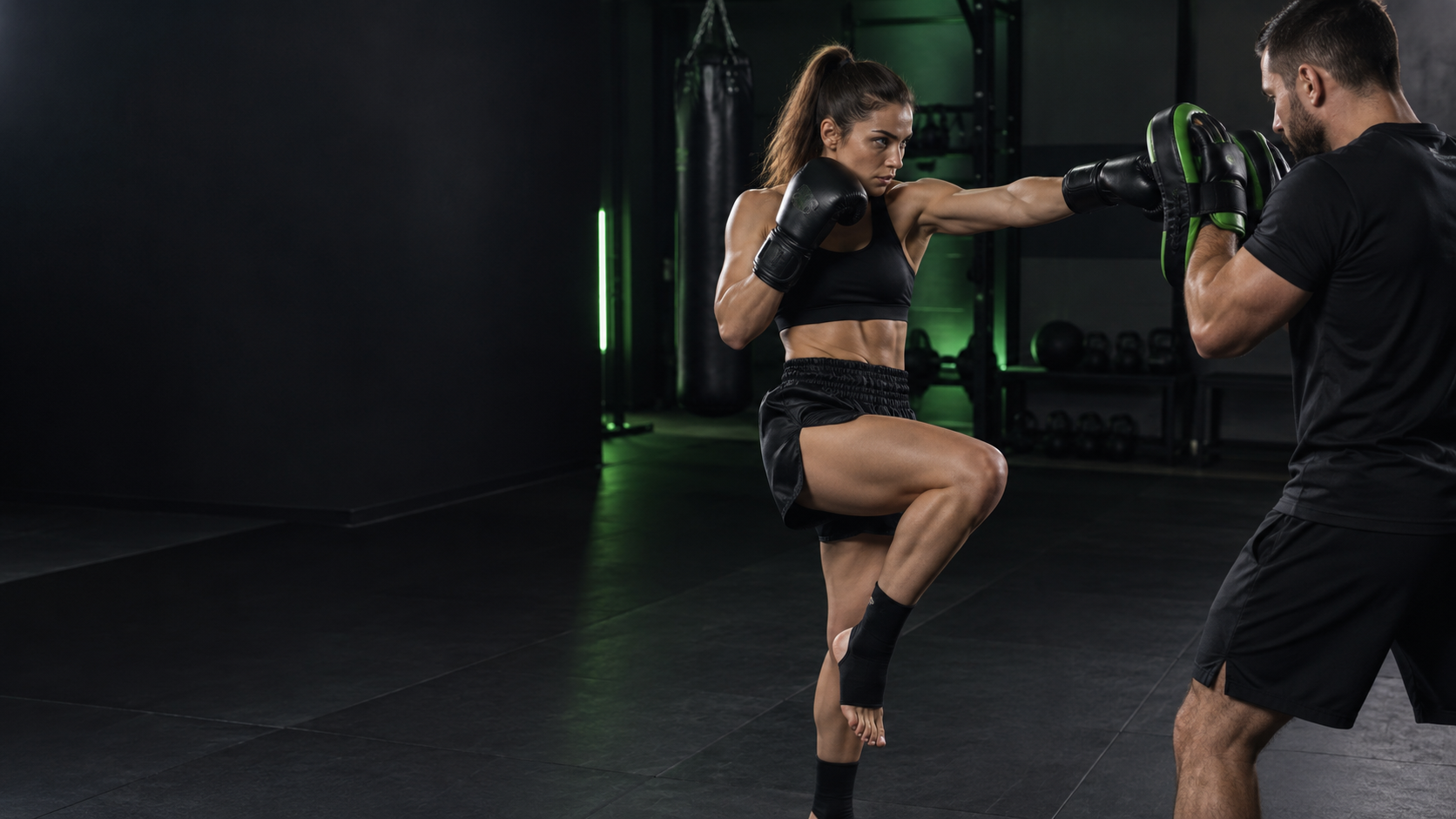
What is the main difference between boxing and kickboxing?
The clearest difference is the number of striking tools available.
Boxing
Boxing focuses on punches.
You learn how to use your hands effectively while developing stance, footwork, defence, distance and timing.
Although boxing uses fewer types of strikes, it has enormous technical depth.
You can spend years improving details such as your jab, defensive reactions, angles, positioning and movement.
Kickboxing
Kickboxing combines punches with kicking techniques.
This means you need to coordinate both the upper and lower body while maintaining balance and controlling distance.
You can attack from different ranges and connect punches and kicks into combinations.
The additional techniques create more options, but they also increase the coordination demands.
Is boxing easier for a complete beginner?
Boxing can initially feel simpler because there are fewer types of strikes to learn.
You do not need to think about kicking mechanics, balancing on one leg or defending against kicks.
That does not mean boxing is easy.
Good boxing requires precise footwork, timing, positioning, defence and efficient punching mechanics.
For a complete beginner, however, having fewer categories of techniques can make the first stage of learning feel more straightforward.
You can focus on stance, movement, punching and defence before dealing with additional complexity.
Is kickboxing harder to learn?
Kickboxing includes more technical elements, but a beginner does not need to learn everything at once.
Training can still begin with the fundamentals:
- stance
- guard
- movement
- basic punches
- distance
- balance
Simple kicking techniques can then be introduced gradually.
You do not need to perform high kicks or complicated combinations during your first sessions.
A well structured training process adds complexity only when you are ready for it.
Do you need to learn boxing before starting kickboxing?
No.
You do not need previous boxing experience to begin kickboxing.
Punching is already an important part of kickboxing and can be taught as part of the training process.
You can learn stance, movement and punching mechanics while gradually introducing kicks.
If kickboxing is the sport you actually want to train, there is no requirement to spend several months learning boxing first.
Which sport uses more of the body?
Both boxing and kickboxing involve the entire body.
A punch is not produced only by the arm.
Effective striking requires coordination between the feet, legs, hips, trunk and upper body.
Kickboxing adds another layer because the legs are also used directly as striking tools.
When you kick, you need to control balance, rotation, posture and the supporting leg while coordinating the rest of the body.
For this reason, kickboxing can feel more demanding from a whole body coordination perspective.
That additional complexity is also one of the reasons many people find it so engaging.
Which is better for fitness?
Both boxing and kickboxing can provide demanding physical training.
Depending on how the session is structured, both can help develop:
- cardiovascular fitness
- coordination
- speed
- general work capacity
- movement efficiency
- strength endurance
However, choosing between boxing and kickboxing only according to which one burns more calories is not particularly useful.
Training intensity depends heavily on the structure of the session.
Technical work can be relatively controlled.
Pad work, combinations and conditioning drills can be much more demanding.
For a beginner, learning good technique should usually come before trying to make every session as exhausting as possible.
Fitness can develop alongside your technical skills.
Which is better if you mainly want to learn practical striking skills?
Both sports can develop useful striking abilities.
Boxing develops punching, movement, distance management, defensive reactions and the ability to stay organised while another person is moving in front of you.
Kickboxing develops many of the same qualities while also introducing kicks and different striking ranges.
Neither sport should be treated as a complete answer to every possible real world self defence situation.
However, if your goal is to improve confidence, striking skills, coordination and the ability to move under pressure, both can provide a strong technical foundation.
Do you have to spar in boxing or kickboxing?
No.
You do not have to spar simply because you train boxing or kickboxing.
Especially at the beginning, training can focus on:
- technical drills
- pad work
- movement
- stance and positioning
- defence
- combinations
- controlled partner exercises
- physical preparation
Sparring can become useful for people who want to learn how to apply techniques against a reacting opponent.
However, it should be introduced according to your experience, goals and readiness.
It does not need to be an automatic part of training.
What if you do not want to get hit in the face?
You can still train.
Learning boxing or kickboxing does not mean that every session needs to involve hard contact.
Private training can be organised around technique, movement, pad work, combinations, defence and controlled exercises.
If you do not want contact to the head, that can be taken into account when planning your sessions.
Training should reflect your goals and the type of experience you actually want.
Is kickboxing only for flexible people?
No.
You do not need exceptional flexibility to start kickboxing.
Beginners sometimes assume that kickboxing requires high kicks from the first day.
It does not.
Basic kicking techniques can be adapted to your current mobility and coordination.
Range of motion, balance and control can also improve gradually through training.
The goal is not to force your leg into a position you cannot control.
The goal is to develop technically sound movement from your current starting point.
Can you start boxing or kickboxing after 30 or 40?
Yes.
There is no requirement to begin combat sports as a child or teenager.
Adults regularly start boxing and kickboxing with no previous experience.
What matters more is how the training is adjusted to your current level, physical capacity and goals.
A beginner who starts at 40 does not need to train like a competitive fighter who has been training since childhood.
Training volume, intensity and technical progression can all be adapted.
Which sport offers more technical depth?
Both do.
The difference is where that technical depth appears.
In boxing, you work within a narrower striking system but can develop enormous detail in areas such as:
- footwork
- head movement
- distance
- angles
- defence
- timing
- punch selection
- combinations
In kickboxing, you also need to integrate kicks and manage the additional tactical possibilities they create.
That affects stance, distance, movement, defence and combination building.
Neither discipline runs out of things to learn.
They simply organise striking in different ways.
Boxing may suit you better if
Boxing may be the better starting point if you are mainly interested in punching technique.
It may also suit you if you particularly enjoy:
- hand combinations
- footwork
- head movement
- defensive reactions
- precision
- speed with the hands
Some beginners also prefer boxing because the smaller number of striking tools makes the early learning process feel more focused.
Kickboxing may suit you better if
Kickboxing may be the better choice if you want to use both punches and kicks.
It may particularly suit you if you enjoy:
- whole body coordination
- kicking techniques
- combining punches and kicks
- working at different striking ranges
- learning a broader striking system
- greater variety in attacking techniques
If learning how to kick is one of the main reasons you are interested in combat sports, starting directly with kickboxing usually makes sense.
What if you still cannot decide?
You do not need to make a permanent decision before your first session.
This is one of the advantages of private combat sports training.
You can begin with fundamental movement and striking skills, experience elements of both disciplines and then decide which direction feels more natural.
Sometimes the choice becomes obvious once you actually begin training.
You may discover that you enjoy the precision and hand work of boxing.
You may find that kicking and combining different striking tools makes kickboxing more engaging for you.
You may also decide that you want to develop elements of both.
Boxing and kickboxing for beginners in Poznan
At TRENUJ I KOP, private boxing and kickboxing sessions are available for complete beginners as well as people who already have combat sports experience.
Training takes place in a private studio inside Andersia Hotel and SPA in central Poznan.
Sessions are available one to one or for two people.
The training process can start with the fundamentals and progress according to your experience, abilities and goals.
You do not need to join a large group.
You do not need previous combat sports experience.
You do not need to improve your fitness before starting.
Sparring is not required.
Sessions can also be conducted entirely in English.
So should you choose boxing or kickboxing?
Choose boxing if you are mainly interested in punches, footwork, defence and the technical details of hand striking.
Choose kickboxing if you also want to learn kicks and enjoy the additional coordination and variety created by combining upper and lower body striking.
Neither choice is objectively better for a beginner.
The better discipline is the one you are more interested in learning and will want to continue practising.
And if you are still unsure, you do not need to decide based only on what you read.
You can start with the fundamentals and discover which type of training suits you better in practice.
Frequently asked questions
Is boxing or kickboxing easier for beginners?+
Boxing may initially feel simpler because there are fewer types of strikes to learn. Kickboxing also includes kicks, which adds additional coordination and balance demands. Both sports can still be taught progressively to complete beginners.
Should I learn boxing before kickboxing?+
No. You can start kickboxing without previous boxing experience. Basic punching mechanics can be taught as part of your kickboxing training.
Do I need to be flexible to start kickboxing?+
No. Beginners do not need to perform high kicks. Kicking techniques can be introduced according to your current mobility, balance and control.
Which is better for fitness, boxing or kickboxing?+
Both can improve fitness. The physical demand depends more on how the session is structured than on the name of the discipline. For beginners, technical development should usually progress alongside conditioning.
Do I have to spar?+
No. Training can focus on technique, pad work, movement, defence, combinations and physical preparation without mandatory sparring.
Can I start boxing or kickboxing with no experience?+
Yes. Previous combat sports experience is not required. Training can begin with stance, movement, basic striking mechanics and defence.
Can I start boxing or kickboxing after 30 or 40?+
Yes. Adults can begin both boxing and kickboxing from zero. Training intensity and progression should be appropriate to your current abilities and goals.
Can boxing and kickboxing sessions be conducted in English in Poznan?+
Yes. Private boxing and kickboxing sessions at TRENUJ I KOP can be conducted entirely in English.
Where does the training take place?+
Sessions take place at TRENUJ I KOP inside Andersia Hotel and SPA, Plac Andersa 3, in central Poznan.